 |
| Self-portrait, Felipe Guamán Poma de Ayala, Inca nobleman who learned Spanish and wrote a chronicle of the ill-treatment of the Indians by the Spaniards. |
Showing posts with label Hispanic. Show all posts
Showing posts with label Hispanic. Show all posts
Saturday, June 29, 2013

Saturday, June 15, 2013
Asking About Bilingualism
Mis tweets hoy:
Many say #beinglatino now means losing #Spanish speaking ability. Anyone w opinions on this topic?
Muchos dicen que #beinglatino ahora significa perder la capacidad de hablar #español. ¿Alguien con opiniones sobre este tema?
Wednesday, September 19, 2012
The Latino Question
Which term is best to describe this ethnic or minority group that often includes many cultures, races, and languages? "Latino" or "Hispanic?"
Wikipedia has a well-annotated article that traces the origin of the word "Hispanic," which comes from the Latin "Hispanicus." This was the adjective derived from "Hispania," which meant the Iberian Peninsula during the time of the Roman Empire. More recently, "Hispanic" has come to mean people of Spanish-speaking descent. Giovanni Rodriguez, whom I quote in an earlier post, has a great discussion in his column the origin and usage of "Hispanic," especially as it applies to Brazilians.
Is Latino the same as Hispanic? As originally used by the Romans, "Hispanic" was used for anyone from the Iberian Peninsula. This would include both Spain and Portugal. Important, since Brazil, the largest Latin American Portugal would be excluded, though, in Hispanic's more recent usage of anyone of Spanish-speaking descent or culture.
If "Latino" has as its root the word "Latin," and all romance languages are derived from Latin, not only Spanish, but also Portuguese. If Latino is a shortened form of "Latinoamericano," that would include Brazil, which speaks Portuguese.
Confusing, since Hispanic can have more than one meaning and Latino can as well. According to Rodriguez, though, these two terms have the same meaning to the census. So for today's purposes, I consider them to be synonyms, although this would exclude Brazilians. The National Center for Biotechnology Information observes that that in the 2000 census, only 7.7% of Brazilians self-identified as Hispanic.
So which do I prefer? Of course, I named this the "Latino Review," so that must indicate something. I like the Spanish sound to the word, and that it seems to be growing as a preferred term among other peoples of Spanish/ Latin American origin in the United States. What I do like about Hispanic, though, is that it automatically includes both genders. As is usual in Spanish custom, the masculine form is used to refer to both genders in the general sense, however, Latina is used when it clearly refers to all women or to a woman in particular. I do not like this, since I don't enjoy being included in the masculine form of the word every time I am lumped together with men. So, like the census and the Pew Foundation reports on Latino/Hispanics, I will use the words interchangeably.
Another great resource for the History and Use of Hispanic and Latino is the New York Times post on its Usage and Style.
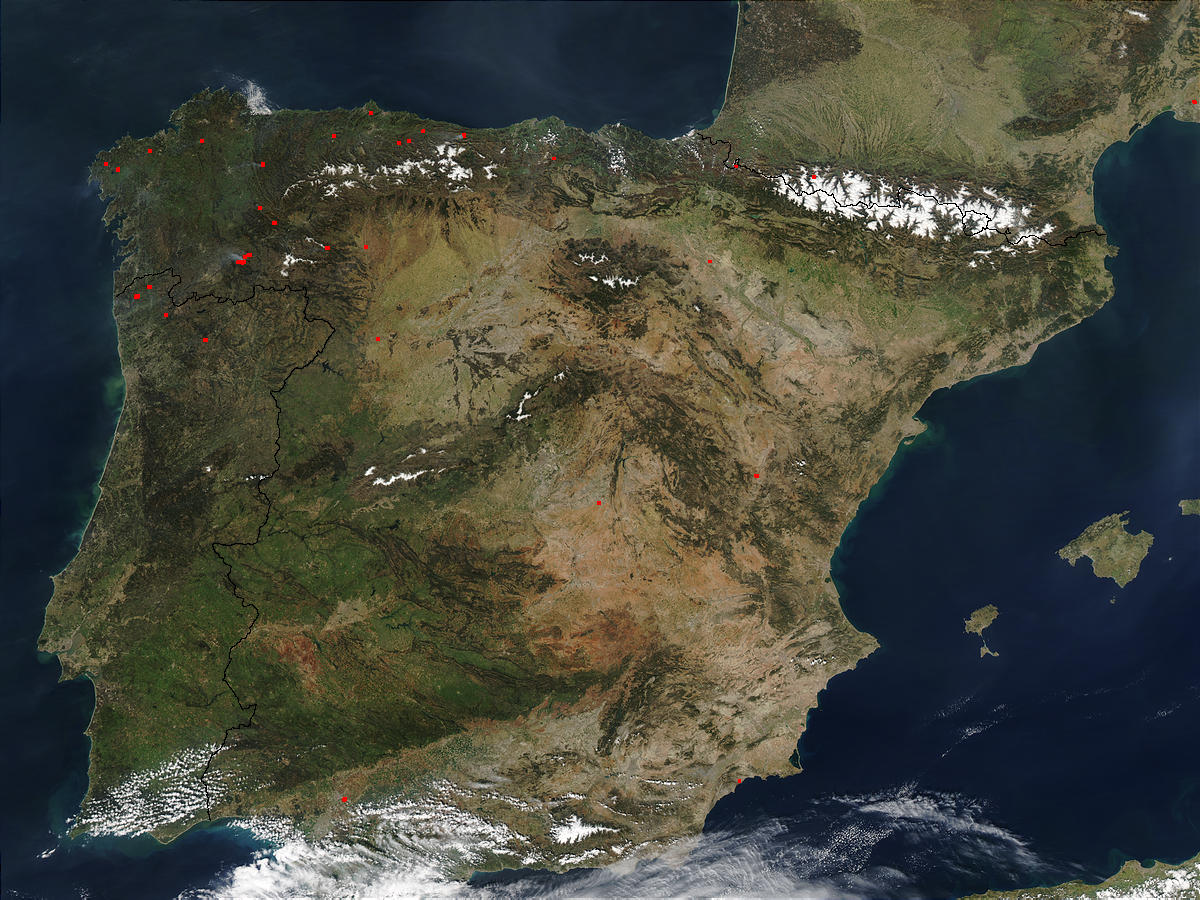 |
Credit:Jeff Schmaltz, MODIS RapidResponse Team, NASA/GSFC |
Is Latino the same as Hispanic? As originally used by the Romans, "Hispanic" was used for anyone from the Iberian Peninsula. This would include both Spain and Portugal. Important, since Brazil, the largest Latin American Portugal would be excluded, though, in Hispanic's more recent usage of anyone of Spanish-speaking descent or culture.
Confusing, since Hispanic can have more than one meaning and Latino can as well. According to Rodriguez, though, these two terms have the same meaning to the census. So for today's purposes, I consider them to be synonyms, although this would exclude Brazilians. The National Center for Biotechnology Information observes that that in the 2000 census, only 7.7% of Brazilians self-identified as Hispanic.
So which do I prefer? Of course, I named this the "Latino Review," so that must indicate something. I like the Spanish sound to the word, and that it seems to be growing as a preferred term among other peoples of Spanish/ Latin American origin in the United States. What I do like about Hispanic, though, is that it automatically includes both genders. As is usual in Spanish custom, the masculine form is used to refer to both genders in the general sense, however, Latina is used when it clearly refers to all women or to a woman in particular. I do not like this, since I don't enjoy being included in the masculine form of the word every time I am lumped together with men. So, like the census and the Pew Foundation reports on Latino/Hispanics, I will use the words interchangeably.
Another great resource for the History and Use of Hispanic and Latino is the New York Times post on its Usage and Style.
Monday, September 17, 2012
Drugs, Money Laundering
This is a letter I wrote to my Representative in Congress, Chris Murphy. One of the reasons I wrote it is because so many Latinos are going to prison for selling drugs, while the money side of the drug trade and the involvement of banks is only beginning to be investigated. Murphy is currently running for senate in Connecticut as a Democrat. He is also my neighbor.
175 Paul Ney Road
Cheshire, CT 06410
(Anadunlop2@gmail.com) (203) 272-8246
June 7, 2012
The Honorable Christopher S. Murphy
Room# 412, Christopher S. Murphy, House Office Building
United States House of Representatives
Washington, DC 20515
Subject: Ethics and Oversight
Dear Chris,
What a great job you are doing on Ethics and Oversight in Congress. I saw on your website that your interest extends to the oversight of government in general. Recently I read about a key aspect of drug crime that affects the U.S. and that I think is huge.
According to the attached article in The Guardian, big banks are making big profits from laundering money for the drug trade. This began to receive major publicity when “it emerged that… cocaine smugglers had bought [a] plane with money they had laundered through Wachovia, now part of the giant Wells Fargo.” (“How a big US bank laundered billions from Mexico's murderous drug gangs” Ed Vulliamy, The Guardian, April 2, 2012.) Wachovia was charged with this crime yet no bank employees were “identified.” The case never came to trial. The outcome was a settlement reached with Wells Fargo, a small fine compared to the profits and damage from their crime.
The case showed that Wachovia’s actions were “only the tip of the iceberg” of bank profits from the drug trade. Vulliamy, the author, writes, “the drug trade has two products, money and suffering.” The inevitable consequence of greed for the money is the suffering of those who are addicted to drugs, victims of organized crime, and the Countries in Latin America experiencing disastrous violence. 97% of drug profits go to the banks and criminal syndicates both here and in other developed countries (described in a separate article by Vulliamy, which I can also send.)
Better oversight is critical to taking on the money laundering. So many branches of government are involved, from law enforcement to bank regulators. Others in Congress who have responsibility for these agencies should also be addressing this crime.
Sincerely,
Ana Arellano
P.S. It’s great being your neighbor and…Red Sox rule!
Saturday, September 8, 2012
"Espanglish is Accepted and Dissed at the Same Time by the Royal Spanish Academy

1. m. Modalidad del habla de algunos grupos hispanos de los Estados Unidos, en la que se mezclan, deformándolos, elementos léxicos y gramaticales del español y del inglés.
My rough translation: Mode of speaking of certain Hispanic groups in the United States in which meanings and gramatical elements of Spanish and English are mixed in a deformed manner.
One of the commentators in the NPR article objects to the characterization of "Espanglish" as "deformed."Let's compare to English. Here is James Nicoll in Wikipedia:
"The problem with defending the purity of the English language is that English is about as pure as a cribhouse whore. We don't just borrow words; on occasion, English has pursued other languages down alleyways to beat them unconscious and riffle their pockets for new vocabulary."
And what of it? There are twenty-six winners of the Nobel Prize in Literature from English speaking countries. Eleven from Spanish speaking countries. And since five of these are from Latin America, we might guess that they do not consult the Academy's "Diccionario" when they write (and perhaps even those from Spain don't consult it either).
Is it unthinkable that someday the Nobel Prize in Literature will be awarded to someone using "Espanglish" in their work, recognizing its creativity and power?
Subscribe to:
Posts (Atom)